Sunday, January 31, 2016

Technology and Bloom's Taxonomy


Img Source: http://digitallearningworld.com/wp-content/uploads/2012/02/bloomspyramid.png
Bloom extensively researched and produced published works about the nature of thinking (Foreham, n.d.). The learning taxonomy he created was used by educators for decades in order to help students develop higher order thinking skills. Though it stood the test of time and has been a valuable resource in the field of education, in the 1990's, one of Bloom's former students sought to update the taxonomy to reflect the changes of the 21st century (Foreham, n.d.). Beyond this revision, we need to connect the levels of higher order thinking skills that students need to develop with appropriate technology to support and enrich their learning.

We are fortunate to live in a connected world with educators collaborating all over the world to build a technologically rich learning environment for our students. In addition to the taxonomy pyramid filled with digital applications for each level of higher order thinking, Allan Carrington built upon a pedagogy wheel that listed verbs and activities related to each level of Bloom's taxonomy by adding digital applications for each level. The applications listed were largely influenced by Kathy Shrock's Bloomin' Apps Guide. Kathy Shrock continues to update her list by encouraging other educators to share resources with her through her website. There is also a collaborative effort in the form of a Google Sheet, originally created by moderators of a Twitter chat, that lists several digital tools that align with Bloom's taxonomy. And these are just a sampling of the many resources that are available for educators looking to boost their students' higher order thinking skills with the help of technology.

So what models allow us to support our students development of higher order thinking through the use of technology? In the next section of this post, I will guide you through some classroom technology scenarios that might be familiar as you consider activities for your own students. You can also look at a Budget Matrix that I developed that discusses the pros/cons of different technology setups, including cost considerations.

The One Computer Classroom

The one computer classroom is, unfortunately, the "norm" in classrooms, mostly due to financial limitations of school districts. While this is not the ideal scenario for individualizing instruction, students can still take advantage of technological learning with this setup. With a projector: 1) teachers and students can make presentations, 2) students can Skype or do a Google Hangout with an expert or connect with classrooms across the globe, 3) as a class or team they can create quizzes on Kahoot! for teams or other classes to complete, 4) students can take turns and post individually to a shared Padlet board, and 5) as a class students can do shared writing projects. With a document camera, students can share individual solutions to math problems and critique and help revise each other's writing. Another teacher, Stephanie Erickson (personal communication, SNHU Discussion Board, January 2016), also recommended a creative solution of building a shared cluster of computers by combining classroom computers of a team of teachers on a rolling cart or table.

The Small Computer Cluster Classroom

Some classrooms are lucky to have a cluster of computers in the classroom. For example, I have 6 Chromebooks in my classroom. My students work on a rotating schedule using different websites to target their individual learning needs. A cluster of computers can also be appropriate when students need to collaborate on a project. For these types of projects, the instructions should include different components that require students to spend time both on and off the computers. Finally, students can work in teams to respond to questions on platforms like Socrative in a friendly, competitive environment.

The Chromebook Cart (1:1 Computing)

Short of 1:1 computing school-wide, a Chromebook cart is the ideal classroom technology configuration. Because they are cheaper, they are more easily acquired and a district can purchase several Chromebook carts for the price of a single computer lab. However, these remain a shared resource so scheduling could be problematic depending on the popularity of these devices among teachers and the number of carts. Furthermore, Chromebooks use web-based applications, so if the network is malfunctioning, the Chromebooks become inoperative.

Bringing the devices into the classroom saves time and allows students to work individually on projects. Students can also collaborate on assignments even though they are on separate machines. For example, students can work on a writing assignment on Google Docs and provide comments to each other as they work. Students could also complete research projects together and gather information, including images and videos, on a shared Padlet board. With Chromebook management software and individual logins, students are held accountable for their time on the devices as well.

The Computer Lab (1:1 Computing)

Though somewhat similar to a Chromebook cart insofar as students can complete the same type of work and projects with this configuration, there are some issues with this setup. First of all, it is extremely costly so there is likely only one or two complete computer labs per school, which severely limits the ability to schedule ample time for a class to work. Secondly, moving an entire class of students to the lab takes away some of the time that could be used for learning and working. On the other hand, iMacs are much more powerful than Chromebooks. iMacs can have software directly installed on them. iMacs can also function without an Internet connection, so even if the network is down, students could still complete some assignments.

BYOD (Bring Your Own Device)

BYOD (Bring Your Own Device) is becoming a popular trend in schools. However, in my opinion, this is the least functional classroom technology configuration. I will delve deeper into the issues surrounding BYOD in my next post, but for now, I will touch upon a few issues with this setup. First of all, not all students will have devices. Secondly, working with a variety of devices means that teachers will have to know which applications work and don't work on the different devices. Downloading applications to several devices at once might monopolize significant bandwidth or be a very slow process, taking up valuable learning time. Furthermore, when something goes wrong on a device, the teacher or IT person might not know how to troubleshoot it. Even if everything works perfectly, teachers must be very cognizant of the applications they are asking the students to use to ensure that there are no inappropriate ads posted. Finally, ensuring that students stay on task might be more difficult with personal devices.

Aside from these potential issues, BYOD can allow students to access technology to enrich their learning. Students who don't have devices can potentially share with other students. With careful preplanning, students can download the applications prior to class. Professional development surrounding BYOD and mobile applications can help support teachers using this model. Finally, good policies about appropriate usage can help to hold students accountable.

~~~~~~~~~~~~~~~~~~~~~~~~~~~~~~~~~~~~~~~~~~~~~~~~~~~~~~~~~~~~~~~~~~~~~

References

Carrington, A. (n.d.) The Padagogy Wheel V 4.1. Retrieved from http://www.unity.net.au/padwheel/padwheelposter.pdf

Foreham, M. (n.d.). Bloom's Taxonomy. Retrieved from http://epltt.coe.uga.edu/index.php?title=Bloom%27s_Taxonomy

Ronan, A. (2015). 5 Tech Tool Combos for Taking Your Class Global. Retrieved from http://www.edudemic.com/5-tool-combinations-for-globalizing-class/

Shrock, K. (2015). Bloomin' Apps. Retrieved from http://www.schrockguide.net/bloomin-apps.html


Sunday, January 24, 2016

Tools for Data Analysis


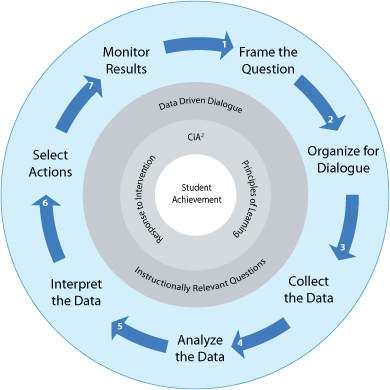
     Students and their achievement are at the center of everything teachers do. Assessment data is extremely valuable in being effective educators. Teachers can use both formal and informal assessment data in order to examine student performance. Using web 2.0 tools such as Google Sheets or Zoho, teachers can organize and analyze student data in order to individualize learning and develop new learning targets for their students. By sorting the data, teachers can make decisions about instructional groupings and teaching methods based upon common student performance.

     In this sample class of twelve students, the teacher wanted to analyze the results of a multiple-choice test to organize the students into small groups. The first step was to input the data into the table. Since we are shifting to Google Schools, and I am a Google Certified Educator, I opted to use Google Sheets. Google Sheets also has add-ons, such as Super Quiz and Flubaroo, that expand its capabilities.
     Once the data was entered into the spreadsheet, I color-coded it using conditional formatting to designate correct vs. incorrect answers. With this information, I was able to identify how many students met the tested standard for each question. This allowed the teacher, not only to see which students needed certain skills and concepts revisited, and which students were struggling to master the concepts overall, but also to reflect upon their teaching practices and inform future instruction, especially when a large percentage of the students failed to master a particular standard. Furthermore, beyond this single test, the teacher now has a foundation for including other measures of student performance and recording more data to analyze student growth.
     In looking at the sample class data, there were about three questions in which more than half the class did not meet the standard. These concepts should be retaught in a whole class setting with purposeful scaffolding of the skills and concepts. During some class activities surrounding these standards, noting which students demonstrated a solid grasp of the standard and which students struggled could help with pairing students together to provide additional in-class support.
     I decided to also sort the student data by overall percentage correct to help identify which students need the most intensive support. This bottom tier has the most gaps to fill; there are potentially foundational gaps that impede the students' ability to master the current grade level standards. Therefore, the teacher should administer other assessments for these students to pinpoint the areas of greatest need. At the same time, stronger students can be enriched; they can delve deeper into the standards they understand through projects involving higher-order thinking skills.
     Using Google Sheets, this data can be shared with colleagues and administrators to observe trends and collaborate to make decisions about possible next steps for instruction. Teachers can use classroom performance and assessments as indicators of student growth, as well as include standardized assessment data. For example, my school uses NWEA Measures of Academic Progress test three times a year to track student progress. I use Google Docs to analyze my students' performance in the various strands as well as document their progress toward their spring score goal. I create instructional skill groups based on the data and ensure that my students are getting the interventions that they need.
     Overall, data is not something that teachers should shy away from. Rather, it is something that should be considered and analyzed daily, and shared in a collaborative environment, in order to improve teaching practices and become more effective practitioners.


Open Data Assessment Sheet in Google Sheets

References:

Logan, L. (2015). 5 Ways to Use Data to Improve Your Teaching. Retrieved from http://www.amplify.com/viewpoints/5-ways-to-use-data-to-improve-your-teaching

Img Source: http://www.dallasisd.org/cms/lib/TX01001475/Centricity/Domain/5173/Data-Analysis-Model_Complete_v5.gif

Sunday, January 10, 2016

Professional Development Survey

This form was created to support teachers in my district with training that is relevant for them.

Saturday, January 9, 2016

TPACK


Image Source: https://lborukedtech.files.wordpress.com/2013/02/tpack2.jpg
What is TPACK? It is an acronym for Technological Pedagogical Content Knowledge. The goal of TPACK is for teachers to connect their existing knowledge of content, pedagogy, and technology to develop effective, technologically-rich lesson plans.


Image Source: http://www.cheatography.com/uploads/davidpol_1443324020_tpack_1_0.png
All three components of TPACK must all interact seamlessly for effective, technology-integrated instruction:

  • Technological Knowledge ~ the knowledge and mastery of technological tools and devices
  • Pedagogical Knowledge ~ the knowledge and practice of teaching, including researched-based best practices
  • Content Knowledge ~ the knowledge of the content and standards that students must achieve

Here is a brief introduction to TPACK by Common Sense Media:

TPACK is extremely relevant for teachers today. If teachers want to implement the TPACK model into their classrooms, it is important for them to remember that they are experts and that they have the deepest understanding of pedagogy and content; teachers in general are not masterful users of technology. If they disregard their pedagogical and content knowledge when implementing technology, teachers will be less effective. Teachers must keep in mind the standards and learning goals.

Teachers have typically been known to plan "technocentrically" (as cited in Papert, 1987), meaning they first select a digital tool and then plan their lessons. However, teachers will build their TPACK knowledge more naturally if they use their pedagogical and content knowledge to plan a lesson and then add appropriate technology enhancements (Haris & Hofer, 2009). Teachers should always plan with the end in mind and choose learning goals and appropriate activities before they select digital tools and resources to support the learning experience. With this purposeful planning, technology becomes an learning tool that aligns with the learning goals, rather than the focus of the lesson.

The biggest obstacle for achieving TPACK is developing teachers' technological knowledge. Professional development remains a crucial element of TPACK. In order for teachers to utilize technological knowledge in their lesson planning, they must first acquire it. School districts and administrators must dedicate time to cultivating a community of technologically proficient educators. Once teachers have a solid foundation of technological knowledge using some universal/core tools, they can begin to connect technology to education. Charts with activities for TPACK development, such as the one compiled by Haris and Hofer (2009), support teachers as they build their TPACK. The TPACK website also has several useful resources. The activities listed are wide-ranging and can be used across the curriculum. Students can use blogs to critique a students' math process or debate politics and discuss the meaning of poetry. Students can use movie-making software to create presentations or make digital storybooks. Technology can be used to create learning opportunities or to demonstrate learning. Furthermore, combining the different types of activities can change learning that occurs. Using the TPACK model makes learning relevant and effective for our students.

References:

Anderson, M. (2013, May 28). Technological Pedagogical Content Knowledge. Retrieved from http://ictevangelist.com/technological-pedagogical-and-content-knowledge/

Haris, J. & Hofer, M. (2009). Instructional Planning Activity Types as Vehicles for Curriculum-Based TPACK Development. Retrieved from http://activitytypes.wmwikis.net/file/view/HarrisHofer-TPACKActivityTypes.pdf

Koehler, M., & Mishru, P. (2008). Introducing TPCK. In M. Koehler, & P. Mishru, Handbook of Technological Pedalogical Content Knowledge (TPCK) for Educators (pp. 3-29). Routledge. Retrieved from http://punya.educ.msu.edu/publications/koehler_mishra_08.pdf

Sunday, December 20, 2015

Hats of the Technology Integration Specialist

 
     The video clip featuring French and Saunders, though comedic, serves as the introduction for this blog post. For some teachers, that scenario is sadly reminiscent of what they experience when they are asked to or attempt to integrate technology without proper training. We know that in general, professional development is key for effective instruction and implementing best practices in the classroom. While educational best practices shift over time, professional development regarding technology integration is especially significant. It's important to remember that not all teachers are native technology users, and even if they are, technology is constantly evolving and new technology is constantly emerging. Teachers need to stay abreast of these changes in order to ensure that technology implemented is relevant and effective for the students.
     Teachers should be comfortable using the technology that they implement. One study examined the difference between the discourse of digital native teachers and digital immigrant teachers and their students. The terms digital native and digital immigrant, coined by Marc Prensky (2001), refer to those who were born into the digital world and those who were not, respectively. The data analysis from the study indicated that digital native teacher possessed the skills to support her students, whereas the digital immigrant teacher lacked them. The digital immigration teacher demonstrated “hesitation, repetition, avoidance, divergence, and negation” because of her lack of technological competence (Grigoryan & Babayan, 2015). This is an indication of a broader problem between digital native students and digital immigrant teachers who do not speak the same language. While the study didn't delve into possible remedies for this discourse gap, professional development could certainly help to bridge the gap.
     Technology should enhance and enrich our students' learning experiences; it should have strong curricular ties and its integration should be seamless. This ideal can only become reality through proper training and support. A technology integration specialist wears many hats in this regard. A technology integrator is a teacher, coach, mentor, and advocate. They need to have the experience in the classroom to understand the curriculum and the students as well as the experience with technology to support the teachers. They need to advocate for time and resources so that technology is available and accessible. They need to work closely with the administration to make sure that teachers and student have the tools that they need to make technology integration effective.
    While a technology integration specialist is key in many ways in bringing technology to the forefront of education, professional development probably remains the biggest aspect of the job. A technology integration specialist should "provide consistent, frequent training and opportunities to practice new skills" (Don Macintosh, personal communication, September 27, 2014). A typical problem with professional development is that teachers are showered with new ideas in a single workshop and then left on their own to figure out how to use them. One idea to remedy this is to for the technology integrator to host weekly workshop hours in a computer lab to give teachers time to collaborate and try new things with built-in support. Technology integrators also need to be available to work with students and teachers in the classroom by modeling lessons and providing an extra hand during projects involving digital tools. With these strategies for professional development in place, teachers will begin to think of technology as a natural part of their pedagogy and lesson planning, rather than an additional burden or afterthought. Technology integration is much more effective when teachers consider "technology in education as part of the pedagogical process" (Okojie, Olinzock, & Okojie-Boulder, 2015).

References

Grigoryan, T. & Babayan, N. (2015). Digital Natives and Digital Immigrants in a Paperless 
     Classroom. International Journal of Arts & Sciences, 8(1), 289-296.

Okojie, M., Olinzock, A., & Okojie-Boulder, T. (2015). The Pedagogy of Technology Integration.
     The Journal of Technology Studies.

Prensky, M. (2001). Digital natives, digital immigrants. Retrieved September 12, 2014, 
     from http://www.marcprensky.com/writing/

Saturday, July 25, 2015

GAFE New Hampshire Summit 2015


When I registered for the Google Summit, I was certainly excited to learn about how to implement Google Apps for Education in my classroom and support my colleagues with additional technology integration. What I didn't know was that I would get all that and much, MUCH more.

For two days I was part of a network, a team, of educators with a common goal. For two days, I was immersed in a stimulating learning environment centered around how to use Google's seamlessly integrated applications to support student learning.

On the first day I was inspired and totally pumped up by Jennifer Scheffer's key note speech where she encouraged us to not take baby steps [with technology], but to take a plunge and try BIG things! I haven't quite decided what my big thing will be this year, but I know it'll involve Google Apps for sure!

I then attended sessions led by the experts, such as Allison Mollica, an extremely knowledgable and energetic GAFE Leader who introduced me to her Treasure Trove of Greatest Hits with add-ons such as Tab Cloud, a list app called Google Keep, Gmail Labs, which allow the user to customize Gmail, and Google Docs research feature, to name a few. The quick tips and tricks that she interjected throughout the presentation were just as helpful as the planned presentation!

My brain was full after learning about the add-on Flubaroo, an automated system that can be used with Google Sheets to grade quizzes and tests created with Google Forms, and learning different ways to use Google Sites and Google Play to tailor instruction for all levels of student learning.


We ended the day with a "Demo Slam" where each presenter got 2 minutes to share a cool site, tip, or trick that we could use. We learned some cool Google omnibox tips and tricks such as how to create two letter shortcuts for frequently used sites and the site http://www.makeuseof.com/ for more quick tips. Products like Air Parrot and Reflector were also introduced, that allow devices to be mirrored. (I even WON a free license for Reflector and can't wait to test it out once the school year starts.) 

The second day was launched with the same energy and enthusiasm as the first. Ben Rouse opened his keynote presentation by posing the question, "Is Change the Only Constant?" With technology ever-evolving, this seems to be the truth of our classroom experience. Teachers need to keep up with the changes to support students; teachers need to understand how to use technology to enrich and enhance student learning. However, this does not mean simply replacing teachers with technology, because, as Arthur C. Clark said, "any teacher that can be replaced by a machine should be." Teachers need to remain facilitators of meaningful and authentic learning experiences.


The rest of the day was spent learning about "A Day in the Life of a Google Classroom" with Allison Mollica and then learning about Google Tour Builder, which, though still in Beta, is one of my absolute favorite new apps! It allows the user to build virtual tours that include images, videos, and written descriptions. This program has many great educational uses. For example, the second grade class in my school district used to go on a walking tour to learn about community helpers. They visited the police station, library, and the fire station to name a few. Though this trip was discontinued, the students now still have the opportunity to virtually visit all of these places! Furthermore, students can create their own virtual tours based on places they are studying, explore places in literature, and more!


Overall, this was the best two days of hands-on learning and collaboration that I have ever experienced. All teachers and leaders present had a common goal and I left the conference with new ideas, tools, and most importantly, an expanded network of colleagues!

#giesummit @jlscheffer @amollica +BenRouse